
Atkinson County Court Records After a Jail Arrest
Atkinson County court records after a jail arrest should be read as a sequence, not as one single database entry. The local jail record starts when an arresting agency brings a person to the Atkinson County Jail or, because of Atkinson's housing arrangement, to Coffee County for female inmates and male overflow when Pearson beds are full. The public roster may show arrest date and time, arresting officer, charge descriptions, statute fields, court fields, warrant numbers, total bond, custody status, and release information when those fields are populated.
The court record is different. The Alapaha Judicial Circuit District Attorney decides what charges are formally pursued in Superior Court, and the Atkinson County Clerk of Superior and Juvenile Court files criminal felony and misdemeanor cases. Use jail inmate records for custody, booking, bond, and roster fields. Use jail mugshots for the separate question of whether a booking photo exists or can be requested. A court record after an arrest is mainly about filed charges, case events, disposition, and whether the accusation changed after booking.
How to Find Atkinson County Court Records After an Arrest
No free official Atkinson online criminal case search portal was located in the research. The clerk page links PeachCourt for civil e-filing and GSCCCA tools for deeds, plats, UCC, notary, and liens, but those are not a local criminal defendant lookup. The Alapaha Judicial Circuit site publishes calendars and court resources, which can support a case search, but it should not be treated as a complete criminal case index.
- Start with the jail roster only to gather arrest date, warrant number, charge wording, statute field, bond amount, and the court field if shown.
- Contact the Clerk of Superior and Juvenile Court with the defendant's full name, date of birth if known, arrest date, charge, and case number if one appears on paperwork.
- Use the Alapaha Judicial Circuit calendars to check court sessions, judge information, and circuit-level resources when a hearing date is the missing fact.
- Contact Magistrate/Probate Court for traffic, magistrate matters, orders to apprehend, and citation-payment questions that may not be filed as a Superior Court criminal case.
- For prosecution questions that the clerk cannot answer, ask the Alapaha Judicial Circuit District Attorney whether a booking charge has become a filed Superior Court charge.
For broader criminal-history access, the Atkinson sheriff forms page includes a name-based criminal history form. The research notes purpose code P for public records and purpose code U for a personal copy. That kind of search is not the same as a case file from the clerk, and it may not show every document in a court record after an arrest.
The Alapaha Judicial Circuit website is a useful support source for calendars, judges, and resources tied to Atkinson, Berrien, Clinch, Cook, and Lanier Counties.
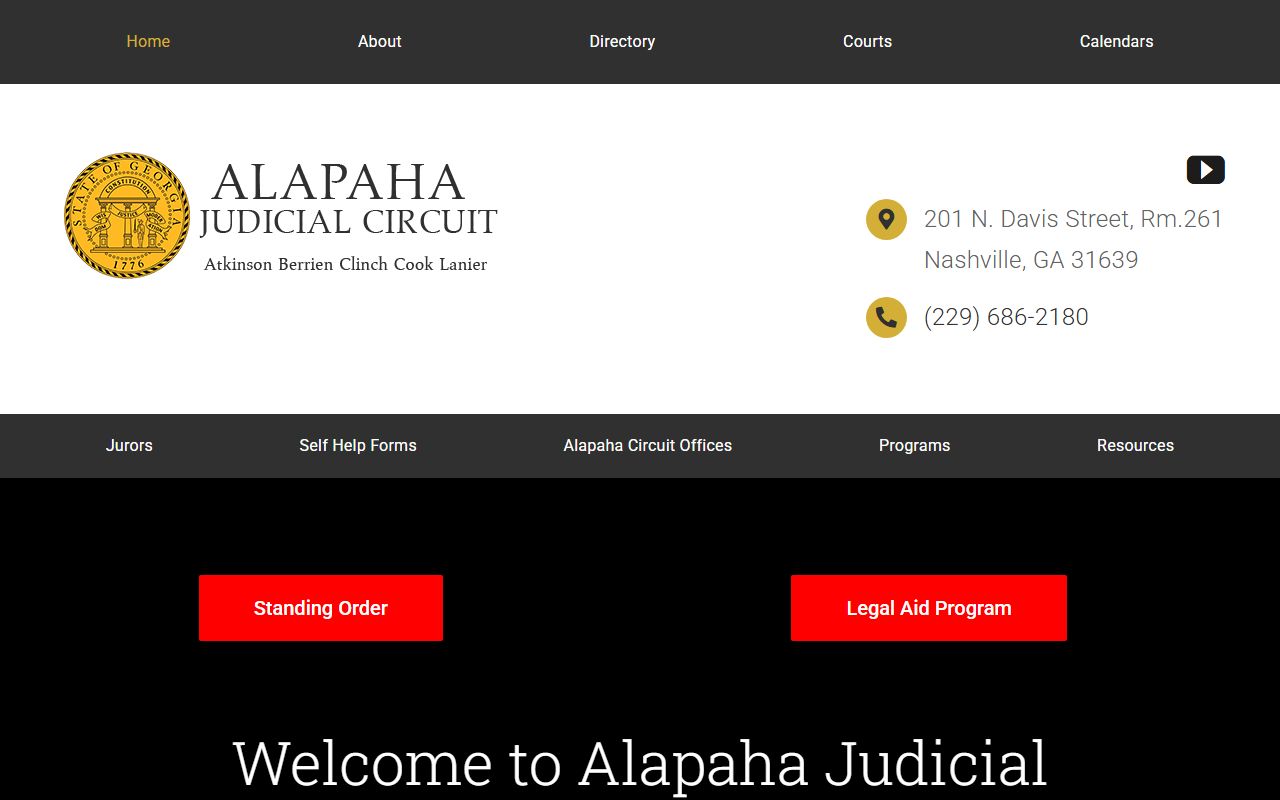
The circuit site helps orient a reader to the court system, but Atkinson criminal case copies still route through the clerk or the appropriate court office when no public case-search portal is available.
Atkinson Clerk, Magistrate Court, and DA Contacts
The courthouse contact details matter because Atkinson does not publish a full online criminal case-search portal. The Clerk of Superior and Juvenile Court is Cynthia G. Dillingham, active clerk since 2014. The clerk's office is at 717 Main Street North, Pearson, GA 31642, with mailing address P.O. Box 6, Pearson, GA 31642. The phone is 912-422-3343, fax is 912-422-7025, and listed office hours are 8:00 a.m. to 5:00 p.m., Monday through Friday, closed from 12:00 p.m. to 1:00 p.m. for lunch. Clerk emails listed in the research are cynthia.dillingham@gsccca.org, angie.stone@gsccca.org, and crystal.bell@gsccca.org.
Probate Judge and Chief Magistrate Judge Carol G. Durrance handles the Probate/Magistrate office. That office is at 717 N Main Street, Pearson, GA 31642, with mailing address P.O. Box 855, Pearson, GA 31642. The phone is 912-422-3552, and hours are 8:00 a.m. to 4:30 p.m., Monday through Friday. Probate clerk Linda Gail Davis is listed at l.davis@atkinson-ga.org, and Magistrate clerk Sharee Corbitt Combs is listed at c.combs@atkinson-ga.org. The court page also warns that staff cannot provide legal advice under O.C.G.A. 15-6-52, so questions should ask for records, dates, copies, and procedures rather than legal strategy.
The Atkinson District Attorney contact is part of the Alapaha Judicial Circuit. Current DA Chase L. Studstill prosecutes felony and misdemeanor offenses in Superior Courts across Atkinson, Berrien, Clinch, Cook, and Lanier Counties. The Atkinson DA page lists phone 912-422-7111 and fax 912-422-7516. The circuit main address is 201 N. Davis Street, Room 261, Nashville, GA 31639, phone 229-686-2180.
How Charges Get Filed After an Arrest: Complaint, Accusation, and Indictment
A jail arrest may begin with an officer's charge or warrant entry, but a court case depends on what is filed and pursued. In Atkinson County, early proceedings may involve Magistrate Court, especially first appearance, bond, traffic, magistrate matters, or orders to apprehend. The DA then decides what Superior Court charges move forward. The clerk files criminal felony and misdemeanor cases, so the filed court record may not match the original roster wording.
| Complaint or Citation | Accusation / Information | Indictment | |
|---|---|---|---|
| Filed By | Officer, court, or prosecutor depending on the matter | Prosecutor | Grand jury after prosecutor presentation |
| Common For | Traffic, magistrate matters, warrants, and initial proceedings | Many prosecuted misdemeanor or felony matters where allowed | Serious felony cases and cases presented to a grand jury |
| What It Does | Documents the alleged offense or starts a lower-court process | States the formal charge the prosecutor chooses to pursue | Charges a defendant by grand-jury action |
| Why It Can Differ From Booking | The jail may list the arrest charge or warrant wording | The DA may amend, reduce, add, dismiss, or decline charges | The grand-jury charge may be narrower, broader, or differently worded |
Charge Status in Court Records After an Arrest
Charge status is the reason a court record should be checked after reviewing the jail roster. A booking entry may show the charge that brought the person to jail, while the court file shows what happened after prosecutor review and court action. One arrest can include multiple counts, different statute fields, a warrant number, and a bond amount, but the final filed case may use different language.
| Status | What It Means |
|---|---|
| Pending | The charge has not been finally resolved by dismissal, plea, verdict, or other disposition. |
| Amended | The filed charge was changed, often because the prosecutor corrected wording, statute selection, count structure, or facts. |
| Reduced | The charge moved to a lesser offense or lower classification than the original booking or filing suggested. |
| Dismissed | The court record shows the charge was ended and is not being pursued in that case. |
| Nolle Prosequi | The prosecutor has chosen not to prosecute that charge, commonly shortened as nolle pros. |
| Conviction | A guilty plea, verdict, or adjudication was entered. It is not the same as the arrest itself. |
Bond and Release After an Arrest
Bond information for an Atkinson inmate should be confirmed with the jail at 912-422-3291. The official bond page says to contact the jail for bonding information, and it states that all bonding is done at the Atkinson County Jail. The sheriff contact page adds that inmates may be bonded out at any time, but practical access to money orders can matter because Pearson stores that sell money orders close around midnight.
| Bond Type | How It Works in Atkinson County |
|---|---|
| Cash Bond | Accepted only by money order. The official page says no cash, checks, debit cards, or credit cards are accepted for cash bond. |
| Property Bond | Requires valid photo ID and a $20 money order per bond. Land value must be double the bond amount. |
| Surety Bond | A licensed bonding company may post bond. The sheriff page lists local bonding-company contacts as an official-source listing, not as a guarantee or endorsement. |
| PR / Own Recognizance | Release on a promise to appear rather than cash or property security, if the court allows it. |
| No-Bond Hold | A paid bond will not release the person if another agency hold, warrant, probation or parole hold, federal hold, or immigration detainer blocks release. |
Warrants That Lead to an Arrest
No official Atkinson County active warrant search page was located on the sheriff or county site. A warrant can still lead to a jail arrest, and once the person is booked, the roster may show a warrant number, statute, charge description, court field, and bond. The sheriff office general number is 912-422-3611, dispatch is 912-422-3811 for non-emergency deputy dispatch questions, and 911 is for emergencies. The jail number, 912-422-3291, is the practical custody check after a warrant arrest.
Magistrate Court handles matters including orders to apprehend, traffic, and magistrate court proceedings. For court records after an arrest tied to a warrant, the clerk can help locate filed felony or misdemeanor cases, while Magistrate/Probate Court may be the better contact for lower-court or citation matters. A warrant may also create a no-bond or hold situation, so bond should always be confirmed charge by charge with the jail.
Charges vs. Convictions
An arrest charge is an accusation or custody reason. A conviction is an outcome. That difference is central when reading Atkinson County court records after an arrest because a person can be booked, charged, released on bond, have a count dismissed, have a charge reduced, or later be convicted of a different offense. A roster entry should not be described as proof of guilt.
| Charge | Conviction | |
|---|---|---|
| Stage | Accusation at booking or formal filing | Final or case-resolving court outcome |
| Decision Maker | Officer, warrant, prosecutor, or court filing | Judge, jury verdict, or accepted guilty plea |
| Proof Level | May begin with probable cause or prosecutorial filing | Requires plea or proof beyond a reasonable doubt for trial conviction |
| Record Meaning | Shows what was alleged or filed | Shows adjudication or guilty resolution |
Sealed vs. Expunged or Restricted Arrest Records
Georgia commonly uses the term record restriction rather than describing every cleared record as expunged. The sheriff-hosted GBI/GCIC record restriction form cites O.C.G.A. 35-3-37 and explains that pre-July 1, 2013 arrest restrictions require application at the arresting agency, while later arrests may be handled through prosecutor and court disposition workflow. Eligible dismissals or non-conviction dispositions may support restriction, but the exact route depends on arrest date, charge, disposition, and agency records.
| Sealed / Restricted | Expunged | |
|---|---|---|
| Georgia Usage | Record restriction limits public criminal-history access for eligible records. | Often used casually, but Georgia materials in the research focus on restriction under O.C.G.A. 35-3-37. |
| Visibility | Restricted from ordinary public criminal-history access when approved. | Not the default wording for Georgia's GCIC process in the local form. |
| Local Caveat | GCIC restriction does not mean local agencies or private vendors automatically erase every copy. | Do not assume all related jail, court, or third-party records disappear automatically. |
| Fees Noted | Arresting agencies may charge up to $50, and approved GCIC applications require a $25 money order or certified check. | Any separate court process or legal advice should be confirmed with the clerk or an attorney. |
Background Check Considerations
Casual public-record lookup is not the same as a regulated employment, tenant, credit, or insurance background check. The Georgia Open Records Act can support requests for existing public records, but consumer-reporting use has separate federal obligations. A person using Atkinson court records after an arrest for a formal screening decision should use an FCRA-compliant process and verify the final disposition with the originating court.
Important: This private site is not a consumer reporting agency and cannot be used for FCRA-covered decisions.
Restricted Court Records After an Arrest in Atkinson County
Georgia's Open Records Act begins with a broad presumption of access, but O.C.G.A. 50-18-72 allows exemptions and redactions. In Atkinson arrest and court matters, sensitive categories can include juvenile records, medical information, active law-enforcement or prosecution material, restricted or sealed records, personal identifiers, and records that the agency does not maintain in the form requested. O.C.G.A. 50-18-71 generally requires a response within a reasonable time not to exceed three business days, but that does not promise immediate free production of every record. The agency may produce, estimate timing and fees, redact, or cite a legal basis for withholding.